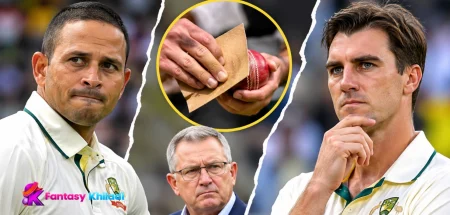
The Sandpapergate scandal has returned to the spotlight in Australian cricket after Cricket Australia announced a new independent forum on November 18, 2026, to address conflicting accounts of the infamous 2018 ball-tampering controversy.
The development follows allegations by former Australian opening batter Usman Khawaja, who claimed in his autobiography Sabr that knowledge of the ball-tampering plan extended beyond Steve Smith, David Warner and Cameron Bancroft — the three players punished in the original investigation.
While Warner has supported Khawaja’s account, Australian Test captain Pat Cummins and other members of the bowling attack have maintained that they were unaware sandpaper would be used on the field.
Cricket Australia CEO Todd Greenberg and interim chairman David Boon announced the independent forum in Hobart on November 18. However, the governing body has clarified that the process will not reopen the original investigation or result in additional punishments.
The controversy has reignited a debate about responsibility, transparency and the culture of Australian cricket during the 2018 South Africa tour.
Why Is the Sandpapergate Scandal Trending in 2026?
The Sandpapergate controversy resurfaced after the release of Usman Khawaja’s autobiography, Sabr, in November 2026.
Khawaja challenged the findings of Cricket Australia’s original investigation, claiming the ball-tampering operation was more widely known among the Australian team than previously acknowledged.
The allegations triggered a series of public disagreements involving Khawaja, David Warner, Pat Cummins and other former Australian players.
The biggest recent development came on November 18, 2026, when Cricket Australia announced an independent forum that would allow players and support staff from the 2018 tour to share their recollections of the incident.
The forum is intended to provide a confidential environment for participants, but Cricket Australia has ruled out reopening the disciplinary proceedings.
The announcement has also attracted criticism from Warner and Khawaja, who have questioned whether the process will provide sufficient transparency.
What Is the Sandpapergate Scandal?
Sandpapergate refers to the controversial ball-tampering incident involving the Australian cricket team during the third Test against South Africa at Newlands in Cape Town in March 2018.
On March 24, 2018, television cameras captured Australian batter Cameron Bancroft attempting to alter the condition of the cricket ball using sandpaper.
Bancroft was subsequently seen attempting to conceal the object in his trousers.
The incident created an international controversy because deliberately changing the condition of the ball using an artificial substance or object violates cricket’s laws.
Following the incident, then-Australian captain Steve Smith admitted that members of the team’s leadership group had discussed a plan to alter the ball.
Cricket Australia’s investigation subsequently identified Smith, David Warner and Bancroft as responsible for the misconduct.
The scandal resulted in lengthy suspensions, leadership changes and a major examination of Australia’s cricketing culture.
Sandpapergate Scandal: Key Facts
| Particular | Details |
|---|---|
| Scandal name | Sandpapergate |
| Original incident | March 24, 2018 |
| Match | South Africa vs Australia, 3rd Test |
| Venue | Newlands, Cape Town |
| Type of misconduct | Ball tampering using sandpaper |
| Player caught on camera | Cameron Bancroft |
| Australian captain | Steve Smith |
| Australian vice-captain | David Warner |
| Players suspended by CA | Smith, Warner and Bancroft |
| New controversy | Allegations in Usman Khawaja’s autobiography |
| Latest major announcement | November 18, 2026 |
| Cricket Australia CEO | Todd Greenberg |
| Cricket Australia interim chairman | David Boon |
| New investigation ordered? | No |
| New player sanctions planned? | No |
What Did Usman Khawaja Reveal About Sandpapergate?
Usman Khawaja’s autobiography, Sabr, has become the centre of the renewed controversy.
Khawaja alleges that knowledge of the ball-tampering operation was not limited to the three players who received suspensions in 2018.
He claims that the wider Australian squad and support staff shared responsibility for the environment and decisions that led to the incident.
One of his significant allegations concerns the second Test against South Africa in Port Elizabeth, now known as Gqeberha.
Khawaja claims sandpaper was also used to alter the ball during that match, before the Australian team was caught during the third Test in Cape Town.
Reserve Australian fast bowler Chadd Sayers has also indicated that sandpaper was used during the Port Elizabeth Test.
However, Khawaja’s claims have not been established by a new official investigation, and several former teammates have disputed his account.
Did the Entire Australian Team Know About the Sandpaper?
This remains the biggest unanswered question surrounding the scandal.
Khawaja’s account suggests that knowledge of the operation was widespread, while Cummins and other Australian bowlers maintain they had no prior knowledge that sandpaper would be taken onto the field.
The distinction between knowing about discussions surrounding reverse swing and knowing about a specific plan to use sandpaper is central to the disagreement.
No new official finding has established that every member of the Australian team knew about the plan.
David Warner Supports Khawaja’s Sandpapergate Claims
Former Australian vice-captain David Warner has supported Khawaja’s version of events.
Warner, who received a 12-month suspension following the 2018 scandal, has questioned whether the original investigation adequately examined the involvement and knowledge of other players.
He has also raised concerns about the limited opportunities some squad members may have had to provide their accounts.
Following Cricket Australia’s November 18 announcement, Warner expressed a preference for an open and independent inquiry rather than a confidential forum.
The former Australian opener has emphasised transparency and accountability while making clear that he is not calling for additional punishments.
Warner’s support for Khawaja has added significance to the renewed debate because he was directly involved in the original incident and faced one of its most severe penalties.
Pat Cummins Rejects Usman Khawaja’s Allegations
Australian Test captain Pat Cummins has firmly rejected allegations that he and other bowlers knew about the plan to use sandpaper during the 2018 South Africa tour.
On November 13, 2026, Cummins addressed the controversy during an extended press conference in Sydney.
He reiterated that he had no prior knowledge that sandpaper would be used to manipulate the ball during the Cape Town Test.
Cummins also rejected suggestions that Australia’s bowlers were involved in organising the operation.
The Australian captain acknowledged problems with the team’s culture during the 2018 tour but maintained that those issues did not establish that every player knew about the illegal ball-tampering plan.
Cummins, Mitchell Starc, Josh Hazlewood and Nathan Lyon had previously issued a joint statement in 2021 denying prior knowledge of the sandpaper operation.
Their position remains an important counterpoint to Khawaja’s claims.
Cricket Australia Announces Independent Forum on November 18
Cricket Australia announced a significant new initiative on November 18, 2026, aimed at addressing the ongoing Sandpapergate dispute.
Interim chairman David Boon and CEO Todd Greenberg confirmed that players and support staff involved in the 2018 South Africa tour would be invited to participate in an independent forum.
The objective is to allow individuals to share their experiences and recollections in a confidential environment.
The forum is expected to be overseen by an independent senior lawyer or former judge, with the process anticipated to take approximately one month.
However, Cricket Australia has explicitly ruled out reopening its original disciplinary investigation.
Key Details of Cricket Australia’s New Sandpapergate Forum
| Feature | Cricket Australia’s decision |
|---|---|
| Announcement date | November 18, 2026 |
| Purpose | Allow players and staff to provide their accounts |
| Participation | Voluntary |
| Eligible participants | Players and support staff from the 2018 tour |
| Oversight | Independent senior legal professional |
| Confidentiality | Participant accounts treated confidentially |
| Expected duration | Approximately one month |
| Fresh disciplinary investigation | Not planned |
| Additional punishments | Ruled out |
| Public release of information | Subject to Cricket Australia’s board decision |
Cricket Australia hopes the forum will help address longstanding disagreements and allow the sport to move forward.
However, the governing body has acknowledged that different participants may provide conflicting recollections.
Consequently, the process does not guarantee a single agreed account of what happened.
Cricket Australia Reveals Details of the 2018 Investigation
Another important development concerns the extent of Cricket Australia’s original investigation.
Todd Greenberg revealed that eight of the 11 players who participated in the Cape Town Test were interviewed during the 2018 investigation.
Several support staff members were also questioned.
The investigation was conducted within a relatively short period because Australia was preparing for the fourth Test in Johannesburg.
The revelation has revived questions about whether every relevant individual had an opportunity to provide evidence.
Cricket Australia’s new forum is intended partly to address this concern by allowing individuals who were not interviewed, or who believe their perspectives were not adequately heard, to contribute.
Nevertheless, Cricket Australia has maintained that its original investigation is complete.
Sandpapergate Scandal Punishments: Which Players Were Banned?
Three Australian cricketers received lengthy suspensions from Cricket Australia following the March 2018 incident.
Cricket Australia Bans
| Player | Position during the scandal | Suspension | Additional consequence |
|---|---|---|---|
| Steve Smith | Captain | 12 months | Barred from Australian team leadership for two years |
| David Warner | Vice-captain | 12 months | Initially received a lifetime Australian leadership ban |
| Cameron Bancroft | Opening batter | 9 months | Restricted from Australian team leadership for one year after his suspension |
The suspensions prevented the players from participating in international and major Australian domestic cricket during their respective ban periods.
Smith and Warner also lost their leadership positions.
Warner’s lifetime leadership ban was subsequently lifted in October 2024 following an independent review.
ICC Penalties
The International Cricket Council imposed separate disciplinary sanctions immediately after the incident.
| Player | ICC punishment |
|---|---|
| Steve Smith | One-Test suspension and a fine equivalent to 100% of his match fee |
| Cameron Bancroft | Fine equivalent to 75% of his match fee and three demerit points |
These penalties were separate from the longer suspensions subsequently imposed by Cricket Australia.
Sandpapergate Scandal Timeline: 2018 to 2026
| Date | Major development |
|---|---|
| March 24, 2018 | Cameron Bancroft caught attempting to tamper with the ball using sandpaper |
| March 25, 2018 | ICC announces disciplinary sanctions against Smith and Bancroft |
| March 28, 2018 | Cricket Australia announces suspensions for Smith, Warner and Bancroft |
| October 2018 | Independent cultural review highlights problems within Australian cricket |
| May 2021 | Cummins, Starc, Hazlewood and Lyon deny prior knowledge of the sandpaper plan |
| October 24, 2024 | David Warner’s lifetime leadership ban is lifted |
| November 2026 | Khawaja’s autobiography revives Sandpapergate allegations |
| November 10, 2026 | Cricket Australia rules out reopening the original investigation |
| November 13, 2026 | Pat Cummins publicly rejects allegations of wider involvement |
| November 18, 2026 | Cricket Australia announces an independent forum for players and staff |
Why Was Sandpaper Used in Cricket?
The purpose of using sandpaper during the 2018 Cape Town Test was to influence the condition of the cricket ball and potentially help Australian bowlers generate reverse swing.
In cricket, swing occurs when the ball moves sideways through the air because of differences in airflow around its surface.
Reverse swing can occur with an older ball when one side becomes significantly rougher than the other under suitable conditions.
Fast bowlers can use this movement to challenge batters, particularly at higher speeds.
While bowlers are permitted to maintain the ball’s condition within cricket’s laws, artificially roughening it with sandpaper is prohibited.
The Sandpapergate incident involved an attempt to gain an unfair advantage by illegally changing the ball’s surface.
How Did Sandpapergate Change Australian Cricket?
The 2018 controversy had consequences beyond the three suspended players.
It led to significant questions about Australian cricket’s leadership, governance and competitive culture.
An independent cultural review conducted by the Ethics Centre identified concerns surrounding the organisation’s win-at-all-costs mentality.
The review produced 42 recommendations aimed at improving standards, accountability and organisational behaviour.
During Cricket Australia’s November 18, 2026 announcement, Todd Greenberg confirmed that 36 of those 42 recommendations had been adopted.
He also acknowledged that Cricket Australia itself shared responsibility for creating the environment in which the original controversy occurred.
Australian cricket subsequently experienced changes in coaching, leadership and team culture.
Pat Cummins has repeatedly emphasised his efforts to improve the team’s behaviour and approach since becoming Test captain.
However, the renewed Sandpapergate controversy demonstrates that disagreements surrounding the 2018 incident have not been fully resolved.
How Have Khawaja and Warner Reacted to the Independent Forum?
Both Usman Khawaja and David Warner responded to Cricket Australia’s announcement on November 18.
Khawaja welcomed the governing body’s willingness to provide an opportunity for people to share their accounts.
However, he questioned whether the process would provide meaningful closure if Cricket Australia’s board retained control over what information could be released.
Warner raised similar concerns and indicated that he would have preferred an open independent inquiry.
Both former Australian openers have expressed a desire for the controversy to be resolved without imposing further sanctions.
Their principal concern is whether the new forum will provide sufficient transparency about the circumstances surrounding the original investigation.
Will Cricket Australia Reopen the Sandpapergate Investigation?
Cricket Australia has confirmed that it will not reopen the 2018 disciplinary investigation.
The independent forum is intended to give individuals an opportunity to provide their accounts rather than determine new responsibility or impose sanctions.
This distinction is important because the announcement does not overturn the original findings against Smith, Warner and Bancroft.
It also does not establish that Khawaja’s allegations are correct or that the bowlers’ denials are inaccurate.
The governing body has acknowledged that conflicting recollections may continue even after the forum concludes.
What Happens Next in the Sandpapergate Scandal?
The next phase will depend on the participation of players and staff involved in the 2018 South Africa tour.
Cricket Australia is expected to establish the independent forum and appoint a suitable senior legal professional to oversee the process.
Participants will have an opportunity to share their recollections privately.
Former Australian coach Darren Lehmann has indicated that he is willing to participate.
However, it remains uncertain how many players will contribute, what additional information may emerge and how much of the eventual outcome Cricket Australia will release publicly.
The process could help address concerns about the original investigation, but its confidential nature may also limit the degree of public closure it delivers.
For now, the competing accounts of Khawaja, Warner, Cummins and other members of the 2018 Australian team remain unresolved.
Conclusion
The Sandpapergate scandal remains one of the most significant controversies in Australian cricket history.
Eight years after Cameron Bancroft was caught using sandpaper during the Cape Town Test, questions surrounding the extent of the team’s knowledge and responsibility continue to generate debate.
Usman Khawaja’s allegations, David Warner’s support and Pat Cummins’ denials have reopened divisions among former teammates.
Cricket Australia’s decision to establish an independent forum represents an effort to address those disagreements without launching another disciplinary investigation.
However, with no additional sanctions planned and the public release of information still uncertain, the process may not fully resolve the questions surrounding the 2018 incident.
For Australian cricket, the latest developments are about more than the original ball-tampering controversy. They concern accountability, transparency and whether the sport can finally move beyond one of its most damaging chapters.
FAQs
1. What is the Sandpapergate scandal?
Sandpapergate is the 2018 ball-tampering scandal in which Australian batter Cameron Bancroft was caught attempting to alter the condition of a cricket ball using sandpaper during a Test match against South Africa.
2. Why is Sandpapergate trending in November 2026?
The scandal has returned to the headlines following allegations in Usman Khawaja’s autobiography and Cricket Australia’s announcement of an independent forum on November 18, 2026.
3. Who were the three players banned in Sandpapergate?
Steve Smith and David Warner received 12-month suspensions, while Cameron Bancroft was suspended for nine months by Cricket Australia.
4. Did Pat Cummins know about Sandpapergate?
Pat Cummins has repeatedly denied having prior knowledge that sandpaper would be used on the field. Claims of wider knowledge remain disputed.
5. What has Usman Khawaja said about Sandpapergate?
Khawaja has alleged that knowledge of the ball-tampering operation extended beyond the three players punished in 2018. He has also claimed sandpaper was used during the preceding Test in Port Elizabeth.
6. What did Cricket Australia announce on November 18, 2026?
Cricket Australia announced an independent forum where players and support staff from the 2018 South Africa tour can share their accounts of the incident in a confidential setting.
7. Will any Australian player face a fresh ban?
Cricket Australia has ruled out additional sanctions arising from the newly announced forum.
8. Was David Warner’s lifetime leadership ban removed?
Yes. Warner’s lifetime Australian cricket leadership ban was lifted in October 2024 after an independent review.
9. How many Australian players were interviewed in the original investigation?
Cricket Australia CEO Todd Greenberg confirmed that eight of the 11 players who participated in the 2018 Cape Town Test were interviewed during the original investigation.
10. Is the Sandpapergate scandal officially closed?
The original disciplinary investigation remains closed. However, Cricket Australia has introduced a new forum to allow people involved in the 2018 tour to discuss their experiences and potentially address longstanding disagreements.